

Trending Now
The craft
“The final surface of a Royal Nilambur piece is finished by hand — feel the absence of machine marks. That is the point.”
Royal Nilambur
Collection
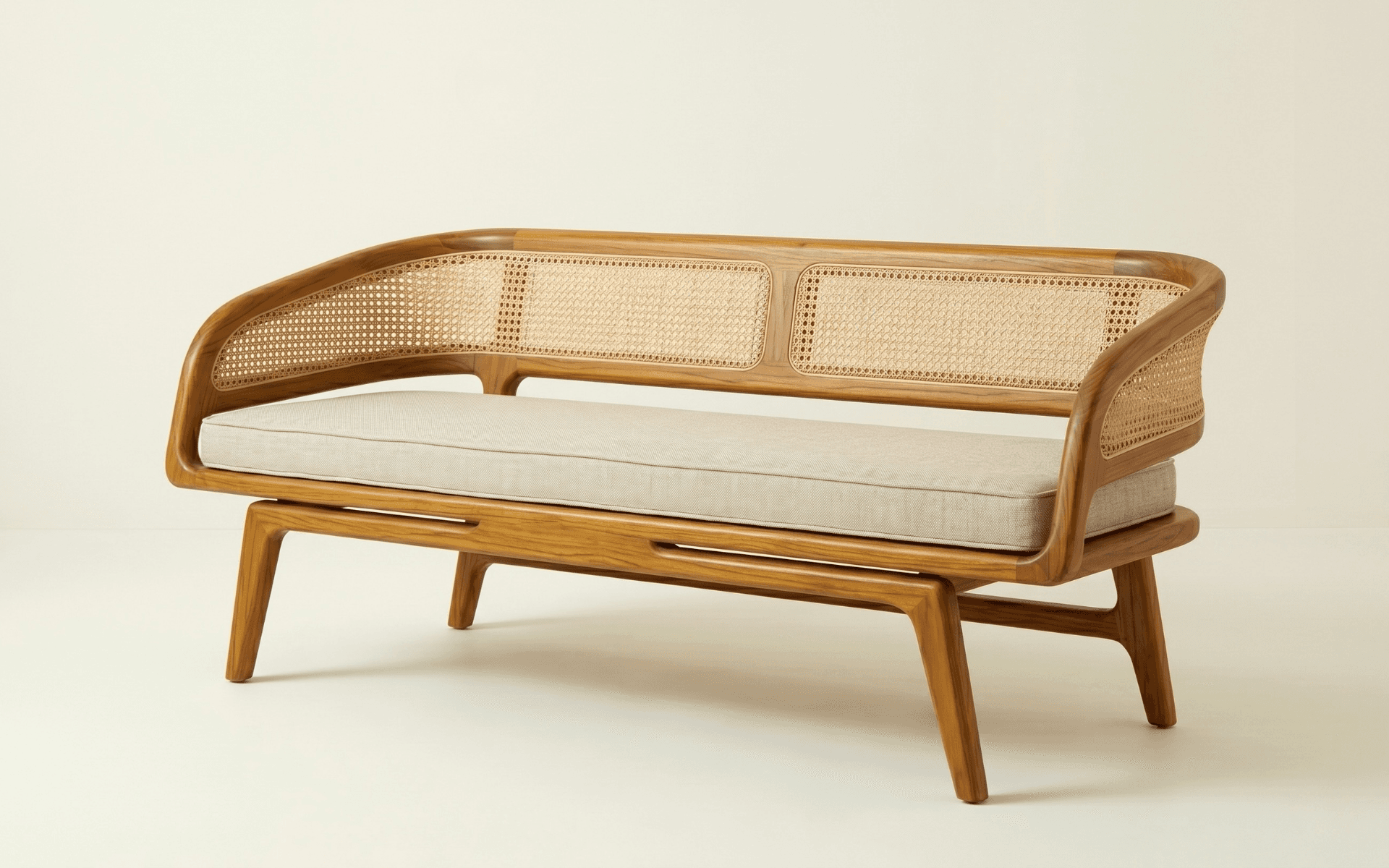
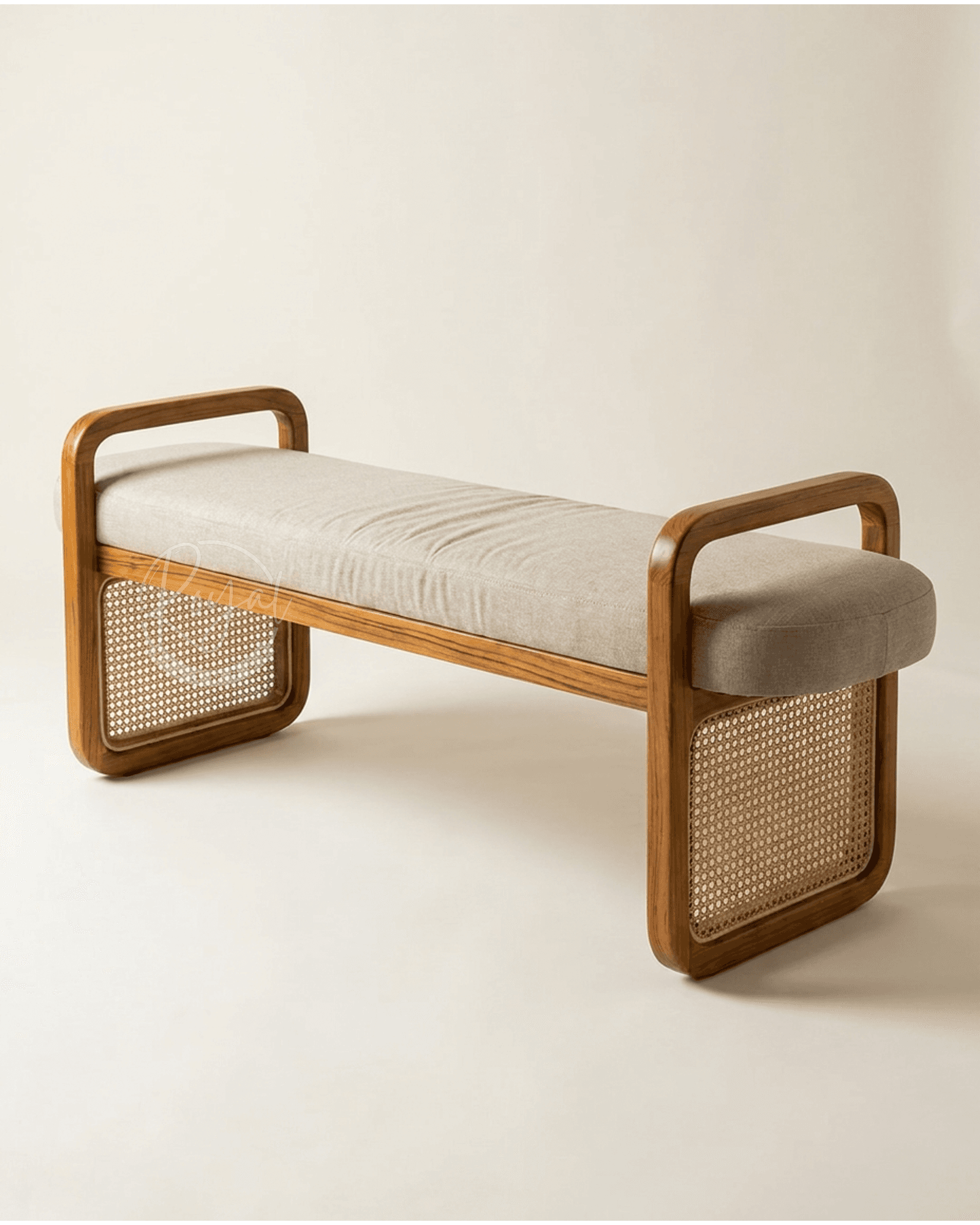
Teak wood benches from Royal Nilambur, made from slow-grown Nilambur wild teak sourced legally from Kerala Forest Department depots. Six bench designs available — from entryway benches to dining benches — each built to order in our Nilambur workshop with mortise and tenon joinery at every structural joint. Unlike plantation teak benches that loosen at the seat rails within a few years, these are made from dense forest teak with a 10-year warranty and a grain that deepens with decades of use.


Every piece is made to order
Handcrafted in Nilambur · 10-year structural warranty · Free delivery across South India
A teak wood bench is one of those purchases that reveals its quality slowly — in the way it holds its shape after years at the foot of a bed, in the way the seat rail never wobbles even after daily use, in the way the grain shifts from pale honey to a deep amber without a drop of polish. Royal Nilambur benches are made from Nilambur wild teak, genuine forest-grown timber procured from Kerala Forest Department depots in Malappuram district. Every piece is built to order in our workshop and carries a 10-year warranty.
The structural demands on a bench are deceptively high. A bench takes point-loaded weight repeatedly — at the centre of the seat, at the ends — and the seat-to-leg joint bears the full brunt of that load every time someone sits down. Solid teak handles this exceptionally well because of its interlocked grain structure and natural density. It does not flex or creep under sustained load the way softer hardwoods do. A teak wood bench built with proper mortise and tenon joinery at the seat rail will remain tight for decades. One with dowels and adhesive will not. This is the distinction that matters when you are buying a bench for your home, not a hotel lobby.
Every bench in this collection is constructed with the following:
Bench dimensions, seat height, and back configuration can be customised at the time of order.
Royal Nilambur is one of the few furniture manufacturers in Kerala working exclusively with wild teak sourced directly from government timber depots. The wood does not pass through a commodity supply chain — its origin is traceable and government-regulated. Your bench is not pulled from a warehouse; it is made specifically for your order by craftsmen in the Nilambur workshop, in a district with over 150 years of teak forestry and woodworking tradition. When you are making a decision that is meant to last 20 to 30 years, the origin and construction of the material matters as much as the design.
The difference between Nilambur teak and plantation teak is not a marketing distinction — it is measurable in the wood itself. Wild teak grown in Kerala's forest conditions develops tighter annual rings because the tree grows slowly through seasonal stress. Tighter rings mean greater density. Greater density means a harder seating surface, better resistance to denting, and superior structural integrity at load-bearing joints. Nilambur wild teak also carries a significantly higher natural oil content than plantation-grown timber, which gives it inherent resistance to fungal decay — relevant for benches used in humid coastal homes in Chennai or Visakhapatnam, where moisture cycling can cause plantation teak furniture to swell and check over time.
Benches serve different functions in different rooms, and the right dimensions depend on where and how the bench will be used.
For a dining bench, the seat height should be between 43 cm and 46 cm — consistent with standard dining chair height. The bench length should be 10–15 cm shorter than the table width it accompanies, so it tucks under cleanly. A 150 cm bench seats two adults comfortably; a 180 cm bench seats three. For entryway or bedroom foot benches, 90–120 cm is the most practical range for a standard Indian bedroom or corridor width.
Consider seat depth as well. A bench used primarily for sitting while putting on shoes can be shallower (30–33 cm); a bench intended for relaxed seating benefits from a 38–40 cm depth. If you are ordering a custom bench, specify both the length and seat depth — our workshop accommodates non-standard dimensions at no additional charge. Delivery to upper-floor apartments is possible; our team can assess dismantling options for staircase clearances on request.
Nilambur teak is wild-grown forest teak from Kerala, procured through Kerala Forest Department depots. It develops much tighter annual rings than plantation teak due to slow forest growth, resulting in higher density and a measurably higher natural oil content. Plantation teak — the most common teak used in Indian furniture — is grown in open plots at accelerated rates, producing softer, more porous timber that requires chemical treatment to achieve comparable durability.
The honest answer depends on how long you intend to use it. A bench built from plantation teak or engineered wood with dowel joinery will typically begin to show joint loosening within 5–8 years of daily use. A Royal Nilambur bench, built from kiln-seasoned Nilambur wild teak with mortise and tenon joints, carries a 10-year warranty and is realistically a 25–30 year piece. Assessed over that period, the cost per year of ownership is lower — and you are not buying again.
Solid wild teak is one of the most dimensionally stable hardwoods available in India. With basic annual maintenance — a light application of teak oil or Danish oil once a year — a properly constructed bench will remain structurally sound and visually rich for several decades. The wood does not require special treatment for monsoon humidity or dry-season heat cycles if it has been correctly kiln-seasoned before manufacture.
Very little. Wild teak's natural oil content means it does not dry out or crack the way lower-oil hardwoods do. An annual wipe-down with teak oil is sufficient to maintain the surface and prevent surface greyingif the bench is indoors. For benches placed in covered verandas or outdoor-adjacent spaces, a light oiling every six months is adequate. Avoid harsh chemical cleaners and prolonged water pooling on the surface.
All Royal Nilambur pieces are made to order in our Nilambur workshop, with a standard lead time of 4–6 weeks from order confirmation. This is the time required to select, machine, and joint the timber properly — not a logistics delay. If you are ordering a custom size or a customised configuration, lead time remains within this window in most cases. We ship to all major Indian cities.
Royal Nilambur benches are made for homes where furniture is expected to last, not to be replaced. Each piece is built to order from Nilambur wild teak, finished by craftsmen who understand the material, and backed by a 10-year warranty. If you know what genuine teak wood furniture looks and feels like, you will notice the difference immediately. If you are buying for the first time, the bench will teach you what the standard should have been all along.