

Trending Now
On buying well
“Solid wood furniture is one of the few things in a home that genuinely appreciates in value over time.”
Royal Nilambur
Collection
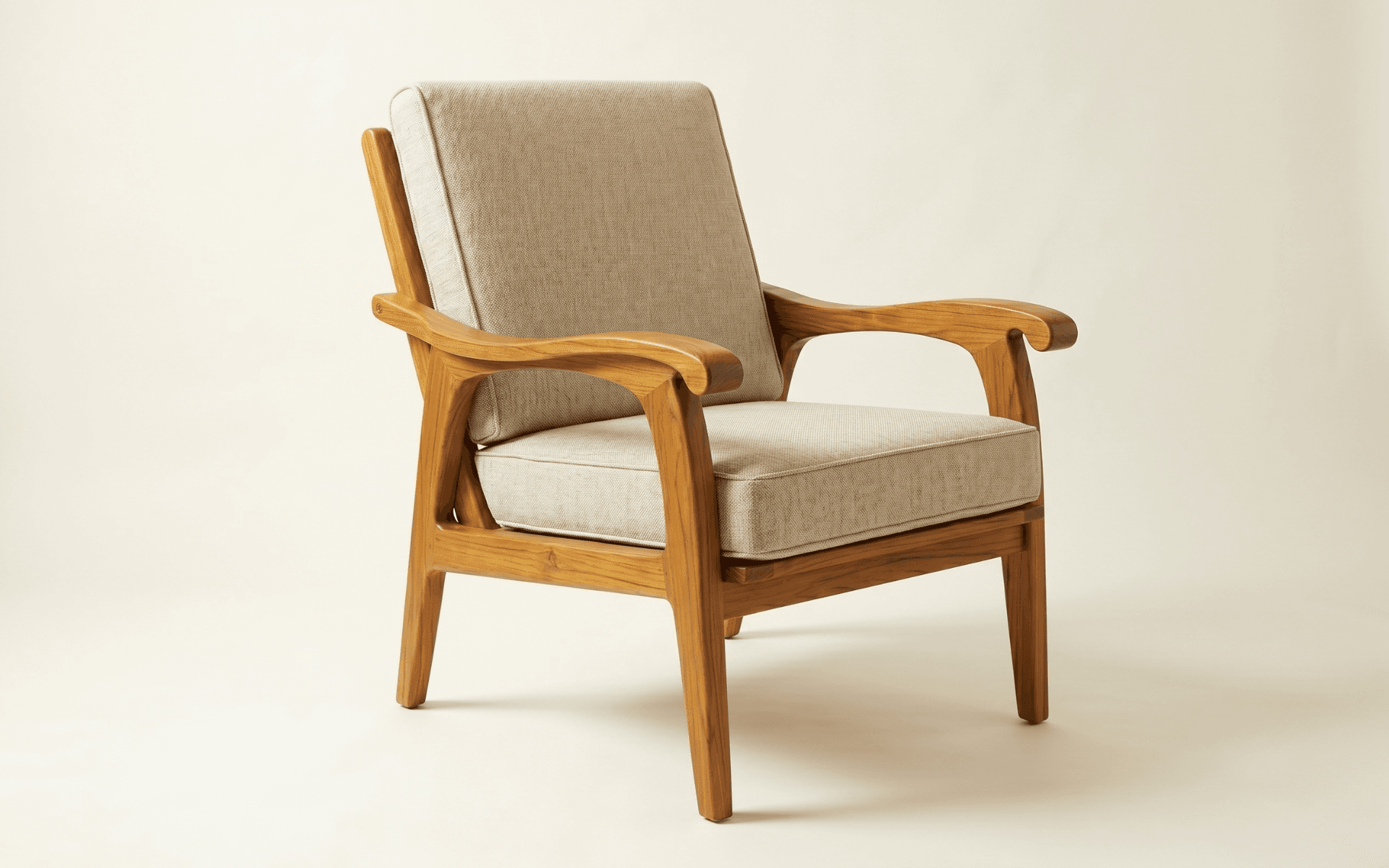
Teak wood furniture in arm chair form reaches its best expression in wild Nilambur teak — a material dense enough to carry daily weight at the arm joints for decades without loosening. Royal Nilambur's arm chairs are made to order at our Nilambur workshop from slow-grown Kerala forest teak, sourced legally from Kerala Forest Department depots. Ten arm chair designs available, each built with mortise and tenon joinery at every structural point. 10-year warranty.
Every piece is made to order
Handcrafted in Nilambur · 10-year structural warranty · Free delivery across South India
Teak wood furniture made for sitting is tested differently from every other category — the arms, the seat rail, the back uprights all carry load at acute angles, and the joinery either holds or it doesn't. Royal Nilambur arm chairs are built from Nilambur wild teak, slow-grown in Kerala's forest belt and sourced legally from Kerala Forest Department timber depots in Malappuram district. This is not plantation wood. The difference shows in the grain, the weight of the piece in your hand, and — most importantly — in how the chair performs after ten years of daily use.
An arm chair carries stress that a dining chair or a stool does not. Every time someone lowers into the seat or pushes up from it, the arm rail and its junction with the back leg absorb a rotational load. In softwoods or fast-grown plantation teak, this junction is the first place a chair begins to wobble. Wild teak from Nilambur grows in Kerala's heavy-monsoon forest at roughly one-third the pace of open-plot plantation teak. The result is wood with measurably tighter annual rings — denser, harder, and less prone to micro-movement at joints over time. For an arm chair specifically, that density at the mortise means the joint does not open under repeated lateral stress. This is the structural argument for genuine forest teak that no finish or veneer can replicate.
Every arm chair in this collection is made to order at our workshop in Nilambur, Kerala. The construction details below are not marketing language — they are the specific choices that determine whether a chair remains solid after a decade.
There is no shortage of brands selling teak wood furniture in India. The honest question is: what teak, and from where? Royal Nilambur sources exclusively from Kerala Forest Department timber depots — government-regulated, traceable procurement with documentation. The workshop is in Nilambur itself, which means the craftsmen work with this specific wood daily and understand its grain behaviour intimately. This is Kerala wooden furniture in the most literal sense: made in Kerala, from Kerala forest teak, by craftsmen whose knowledge of Nilambur wood comes from working with it over years, not from a product brochure. A Royal Nilambur arm chair is a 20–30 year decision. The 4–6 week lead time exists because your chair is built after you order it, not pulled from a warehouse shelf.
Myanmar teak has long been considered a global benchmark. Nilambur wild teak has a measurably higher natural oil content — this is the property that makes the wood self-protective against moisture ingress, fungal rot, and termite activity without any chemical treatment. For a chair used in a coastal city like Chennai or Visakhapatnam, where seasonal humidity fluctuates significantly, this matters: the wood does not swell and shrink enough to stress the joints. The honey-brown colour of freshly worked Nilambur teak deepens and mellows with age — not because of a surface stain that wears off, but because the wood's own oils are responding to light and use. Antique Nilambur teak pieces show a warm amber depth that no new finish can fake.
Arm chairs are among the most personal furniture purchases you will make — the proportions need to suit the body, the room, and how the chair will be used.
Seat height of 43–46 cm works for most Indian adults; if the chair will be used at a writing desk or table, match the seat height to your table height minus 27–30 cm for comfortable clearance. Seat depth of 48–52 cm suits most users for extended sitting — deeper than this and shorter users find themselves perching. Arm height of 20–22 cm above the seat allows the elbow to rest without forcing the shoulder upward. For smaller rooms, a chair with a tighter arm profile (where the arm rail runs close to the seat width rather than flaring outward) keeps visual weight lower.
If you are placing arm chairs in a living room around a central coffee table, allow at least 45 cm of clearance between chair arms for comfortable movement. For a reading corner, a slightly higher-backed arm chair with a wider seat depth tends to be more comfortable over long periods. All Royal Nilambur arm chairs can be made to your specified dimensions — mention your requirements when ordering.
One practical note: solid wild teak arm chairs are heavier than their plantation-teak or engineered-wood equivalents. A standard arm chair in Nilambur wild teak typically weighs 12–18 kg depending on back height. This is not a flaw — it is a direct consequence of the wood's density — but factor it into your room arrangement decisions.
Nilambur teak is wild-grown forest teak from Kerala's Malappuram district, where slow growth in heavy-rainfall conditions produces tighter grain and higher natural oil content than plantation teak grown in open plots. Most teak sold by furniture brands in India is plantation teak from Southeast Asia or domestic farm plots — faster-grown, lower-density, and with less inherent oil. The practical difference shows in joint longevity, surface hardness, and how the wood responds to humidity over decades. Royal Nilambur sources only from Kerala Forest Department depots, so the origin is documented, not a marketing claim.
The honest answer depends on your time horizon. Engineered wood and sheesham furniture at lower price points typically performs well for 5–8 years in normal indoor use. Solid wild teak, properly constructed with mortise and tenon joinery, routinely outlasts 25–30 years without structural failure — the wood's density and oil content protect the joints from humidity-driven movement. If you calculate cost per year of use rather than sticker price, authentic teak wood furniture becomes the more economical choice for most homeowners who plan to stay in their homes long-term.
Genuine solid teak has a distinctive oily feel to the freshly cut surface, a honey-brown colour with visible grain variation (not the uniform pattern of a printed veneer), and is noticeably heavier than engineered alternatives of the same size. On a solid piece, end grain is visible at every cut edge — veneer shows a thin surface layer peeling or meeting a different substrate at edges. The most reliable test is weight: a solid wild teak arm chair of standard dimensions will weigh considerably more than an equivalent veneer-over-MDF piece. Royal Nilambur provides material documentation on request.
Wild teak's high natural oil content means it needs minimal maintenance. Indoors, a wipe with a slightly damp cloth for dust removal is sufficient for regular cleaning. Once a year — ideally before the monsoon — apply a thin coat of raw teak oil or Danish oil to replenish surface oils, particularly if the chair is in an air-conditioned room where the air is consistently dry. Avoid placing the chair in direct sustained sunlight, which fades the natural honey tone faster. There is no need for chemical sealants, waxes, or polish — the wood's own composition handles the rest.
Yes. Because every piece is made to order at our Nilambur workshop, customisation is part of the process rather than an add-on. You can specify seat height, seat depth, arm height, back height, and finish. Structural design changes — such as adding a wider seat or adjusting arm rail profiles — are discussed during the order consultation. Lead time is 4–6 weeks from order confirmation, which reflects the time required to work the wood correctly at each stage rather than rush-cut components for assembly. Mention your requirements clearly when placing your order and our workshop team will confirm feasibility before production begins.
Royal Nilambur arm chairs are made from teak wood that has spent decades forming in Kerala's forest before it reaches our workshop — and they are built to reflect that investment of time. Each piece carries a 10-year structural warranty and is made specifically for you, not stocked in a warehouse. If you are deciding between furniture that looks good today and furniture that remains structurally sound and visually richer in three decades, the conversation starts with the material. Browse the ten designs in this collection, and contact us to discuss dimensions or customisation before you order.