

Trending Now
The forest
“Every log we use is purchased from KFDC licensed depots with a government-issued number traceable to its harvest block.”
Royal Nilambur
Collection
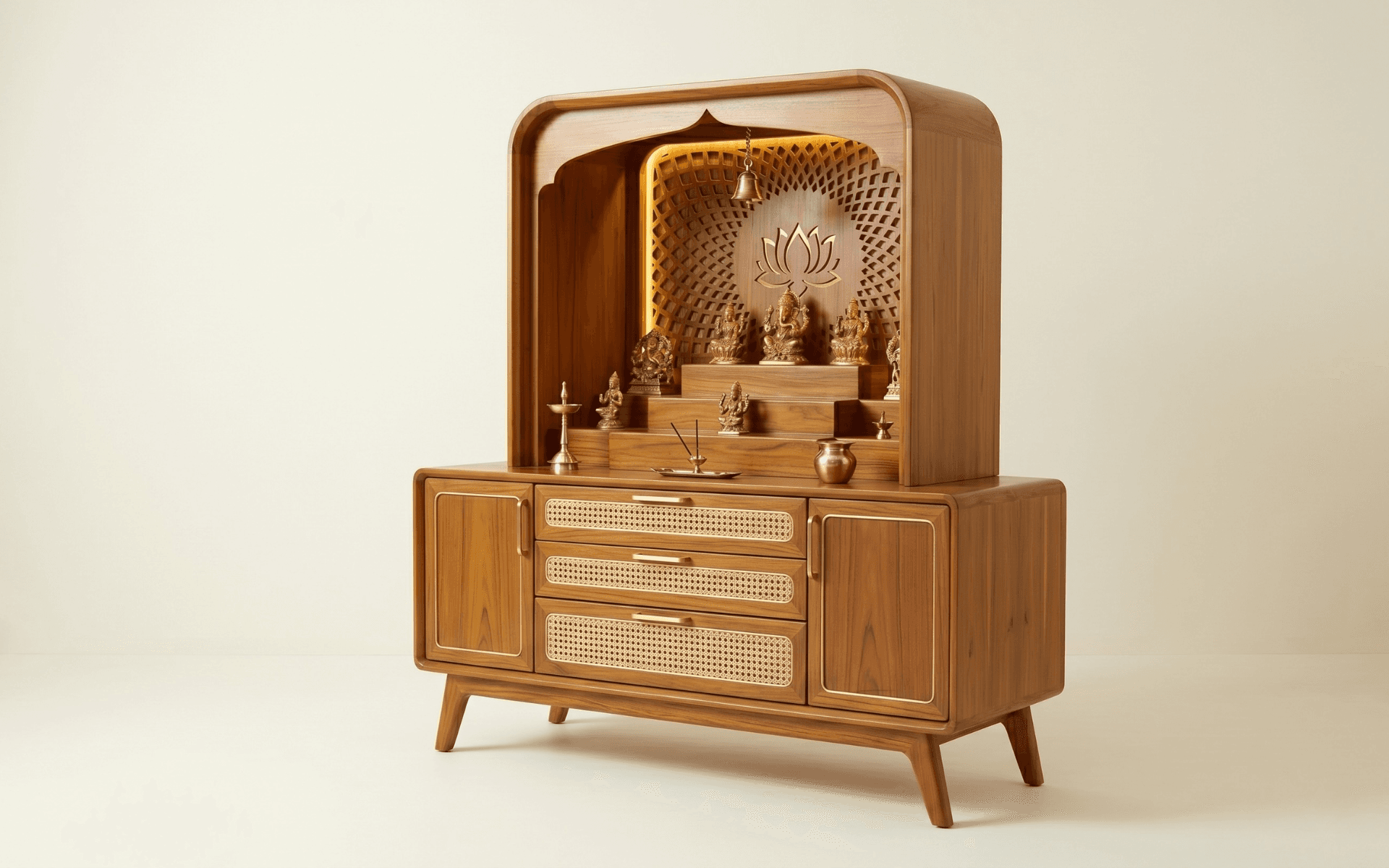
Teak wood pooja mandirs made from genuine Nilambur wild teak — sourced legally from Kerala Forest Department depots in Malappuram district. Each mandir is crafted to order in the Royal Nilambur workshop, with traditional joinery, hand-finished surfaces, and a 10-year warranty. Wild teak's natural oil content and density make it the most fitting material for a piece that will serve daily devotional use across decades.


Every piece is made to order
Handcrafted in Nilambur · 10-year structural warranty · Free delivery across South India
A pooja mandir made from teak wood furniture is not simply a cabinet — it is the devotional centrepiece of a home, used every morning, every evening, for decades. At Royal Nilambur, every mandir is made to order from Nilambur wild teak: slow-grown forest timber sourced legally from Kerala Forest Department depots, worked by craftsmen in our Nilambur workshop who understand both the material and the tradition it serves.
A mandir is among the most frequently used pieces of furniture in an Indian home. Daily incense, oil lamp heat, the gentle humidity of flower offerings, and years of handling demand a wood that does not absorb moisture, does not warp at joints, and does not need chemical protection to maintain its surface integrity. Nilambur wild teak meets each of these requirements through its own material properties — not through surface treatments or engineered construction shortcuts.
Wild teak grown in Kerala's monsoon forests has measurably higher natural oil content than plantation teak grown in open plots. This oil does not need to be applied; it is in every cell of the timber. For a mandir placed in a pooja room or alcove — often a space with limited ventilation, concentrated humidity from diyas and water offerings, and daily temperature variation — this matters in a way it simply would not for a plantation-teak piece.
Our pooja mandirs are made to order, not pulled from warehouse stock. Each piece reflects the specific dimensions, panel configuration, and finish you need for your home.
Royal Nilambur is not a manufacturer that sources Kerala wooden furniture labels for its products — we are based in Nilambur, the town that gave the world its first teak plantation in 1840 and remains the centre of Kerala's teak heritage today. The craftsmen in our workshop learned joinery in this region, from people who spent their working lives with wild teak specifically. That material familiarity shows in how pieces are cut, how grain direction is chosen for structural members, and how finishing is applied to bring out the wood's natural depth rather than mask it.
Every Royal Nilambur mandir is a made-to-order piece. When you commission one, you are not selecting from a photographed catalogue of factory-finished units. You are specifying a piece built for your pooja room, your wall dimensions, your devotional requirements — and it will be made from a log traceable to a Kerala Forest Department depot.
Most urban homes in India accommodate a wall-mounted or freestanding mandir in a dedicated alcove or corner. A freestanding unit typically ranges from 24 to 36 inches wide; wall-mounted units can be narrower. Before ordering, measure the height of the deity figures you intend to place inside — this determines the shelf height needed, not the overall cabinet dimensions. For apartment pooja rooms in Bengaluru or Hyderabad, where space is compact, a wall-mounted teak mandir with a single prayer shelf and a carved torana arch above is often the most practical and visually complete solution.
Consider also the proximity to an external wall or window. Pooja rooms near coastal-facing walls — common in Chennai, Mumbai, or Kochi apartments — benefit from wild teak's natural moisture resistance without any additional treatment. A plantation-teak or engineered-wood mandir in the same position will likely show surface lifting or joint movement within five to seven years.
If you use agarbattis or diyas daily, choose an open-shelf design or one with carved ventilation panels rather than a closed-door cabinet. This allows heat and fragrance to dissipate naturally and protects the wood surface near the flame shelf from prolonged heat exposure.
Nilambur wild teak grows slowly in Kerala's forest conditions, producing tighter annual rings, greater timber density, and significantly higher natural oil content than plantation teak. A mandir made from wild teak will hold its joints, resist moisture penetration near water offerings, and develop a deeper grain character over time — none of which a plantation-teak or veneer piece will replicate. The difference becomes visible within five years of daily use.
A pooja mandir sees more daily handling than almost any other piece of furniture in the home. Incense smoke, oil lamp heat, water from flowers and abhishekam, and the physical routine of opening and closing doors or lifting deity figures all act on the wood continuously. Pure teak wood furniture made from wild Nilambur timber handles this accumulation of use without joint failure, surface degradation, or warping — which is the actual cost comparison to consider against a cheaper alternative that needs replacement in seven to ten years.
A well-made solid teak mandir from wild Nilambur timber, properly cared for, will remain structurally sound for 30 years or more. The 10-year warranty Royal Nilambur provides covers structural integrity, but the material itself is capable of lasting significantly longer. Many teak wood pieces from the Nilambur region made in the mid-twentieth century remain in active household use today.
Very little. Wipe the surface with a dry or lightly damp cloth to remove incense residue and dust. Apply teak oil or a beeswax-based wood polish once every six to twelve months to maintain surface lustre — less frequently in drier inland climates like Delhi or Jaipur, slightly more in coastal homes with year-round humidity. Avoid placing the mandir in direct sunlight for extended periods, which can lighten the grain faster than natural ageing would. No chemical treatment is needed; the wood's own oil content provides the baseline protection.
Yes. All Royal Nilambur pieces are made to order, which means height, width, shelf configuration, door style, and carving details can be specified at the time of commission. Our lead time is 4–6 weeks from confirmed order. If you have a specific alcove width, a particular deity configuration, or a design reference from traditional Kerala temple carpentry you would like adapted, discuss it with us before placing the order — adjustments are straightforward before production begins, not after.
A teak wood mandir made from genuine Nilambur wild teak is a considered decision — and one that is worth taking time over. Every piece we make carries a 10-year warranty, a traceable material origin, and the skill of craftsmen who work with this specific timber every day. When it is ready, it will be the same piece your family uses thirty years from now.