
Trending Now
On buying well
“The things in your home that you use every day deserve to be the best things in it.”
Royal Nilambur
Collection
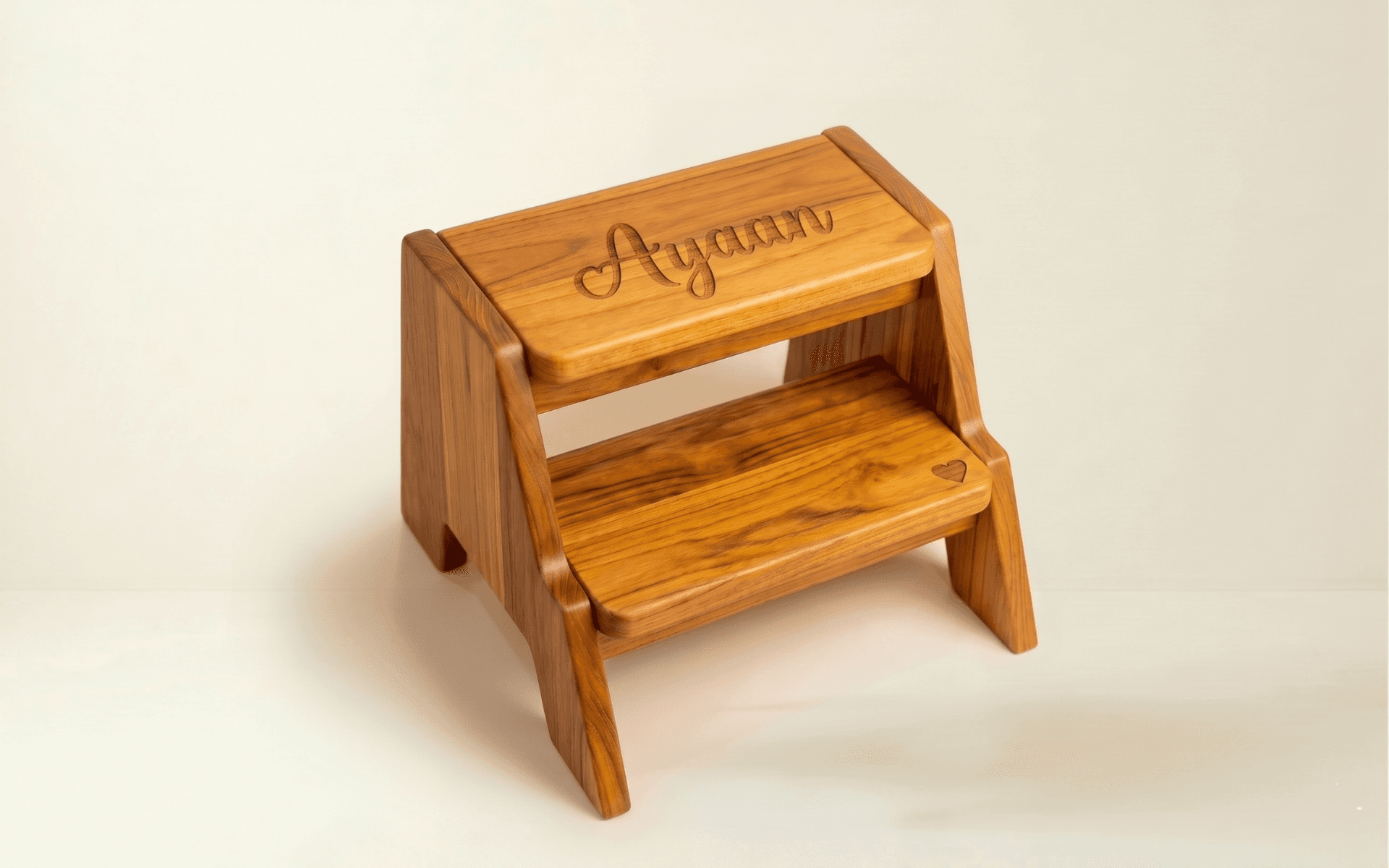
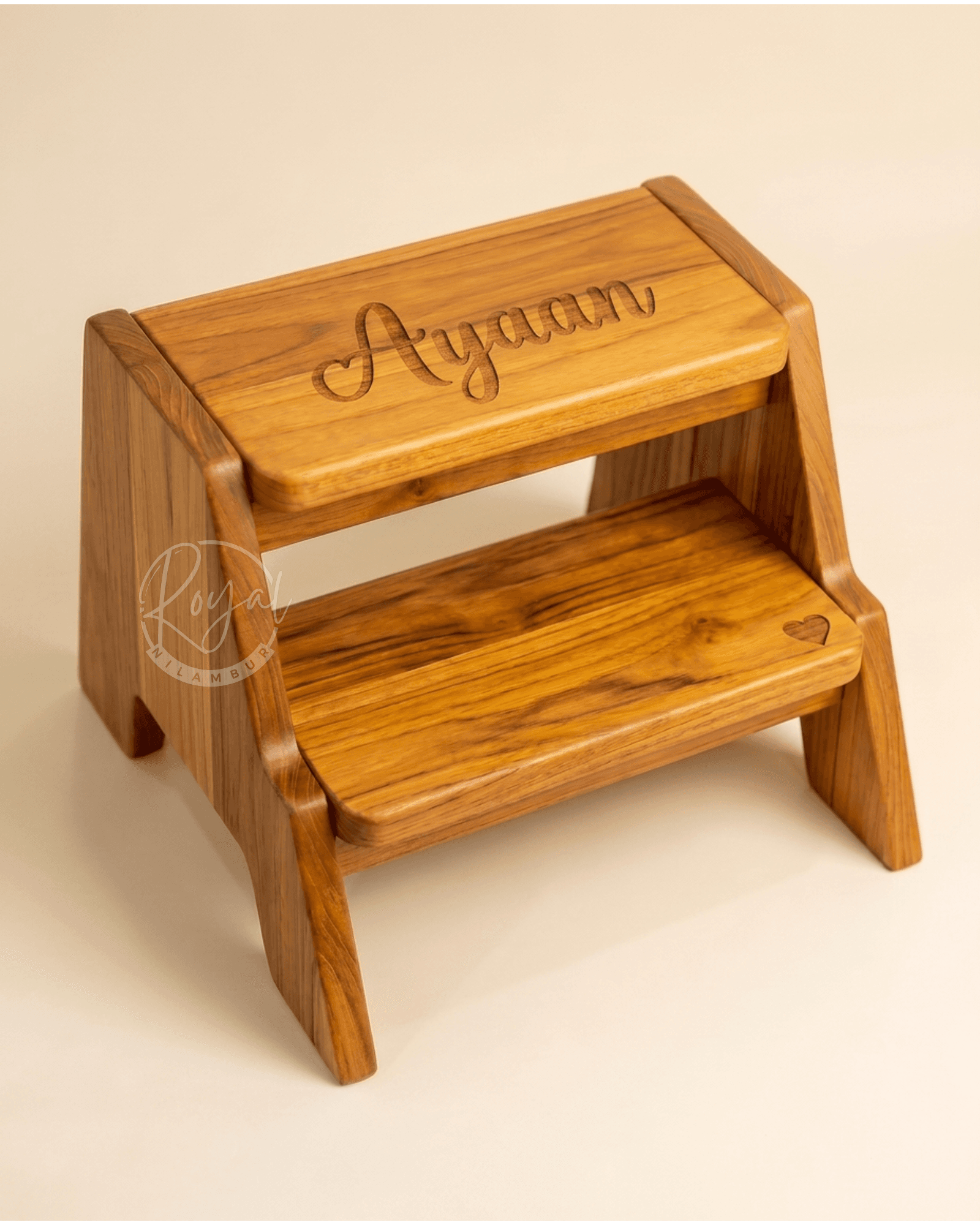
Teak wood step stools from Royal Nilambur are handcrafted from genuine Nilambur wild teak — slow-grown Kerala forest timber sourced legally from the Kerala Forest Department. Each stool is made to order, with options for name engraving, custom heights, and multiple finishes. Far more durable and safer than plastic or engineered wood alternatives, these stools are built for daily use — whether in a child's room, bathroom, or kitchen — and carry a 10-year structural warranty.
Every piece is made to order
Handcrafted in Nilambur · 10-year structural warranty · Free delivery across South India
Teak wood furniture does not have to mean large, imposing pieces. Some of the most considered work coming out of the Nilambur workshop is also the smallest — and a solid wild teak step stool is a good example of why material quality matters even at this scale. At Royal Nilambur, every step stool is made to order from Nilambur wild teak, kiln-seasoned to the correct moisture content, finished to your choice of colour, and engraved with a name if you want it. These are not utility props bought off a shelf. They are small pieces of genuine Kerala wooden furniture, made with the same discipline as a dining table.
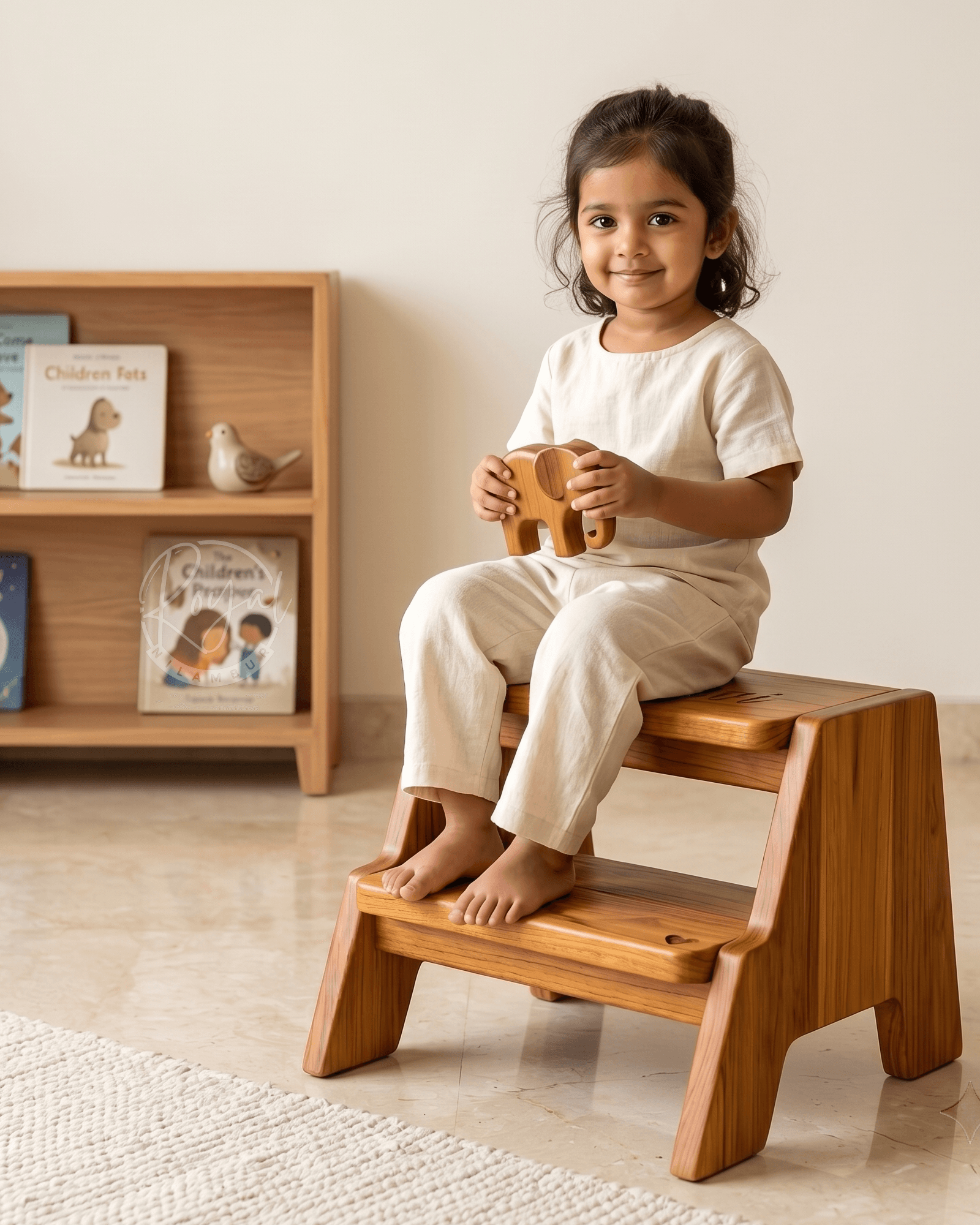
A step stool takes concentrated, repeated loading — a child's full body weight landing on a small surface, dozens of times a day. Plastic stools crack at the legs under this stress. Pine and rubber wood compress and dent at the joint where the leg meets the seat. Wild Nilambur teak, with its naturally dense grain structure from decades of slow forest growth, does neither. The surface resists denting under point load. The legs, joined with mortise and tenon construction rather than dowels or metal brackets, do not work loose over years of daily use. For a bathroom step stool specifically, the high natural oil content of wild teak provides genuine moisture resistance — a property no coating can replicate in the long term once it begins to wear.
Every Royal Nilambur step stool is built with the following, regardless of size or finish:
You can read the full details of what the warranty covers at the 10-year structural warranty page.
Royal Nilambur sources all timber exclusively from Kerala Forest Department depots in Malappuram district — government-regulated procurement with a traceable chain of custody. This matters because the Indian market for "teak" furniture is crowded with plantation teak, import teak, and recycled teak sold without distinction. Wild Nilambur teak is a geographically specific material with measurably different properties: tighter annual rings, higher oil content, and greater dimensional stability over time. A step stool made from this timber is a different object from one made with fast-grown plantation stock, even if both are labelled solid teak. Our workshop and sourcing story explains how we procure and verify every batch of timber we use.
The question most buyers ask about a wooden bathroom stool is whether it will survive the humidity. It is a fair concern — and the honest answer depends entirely on the wood. Nilambur wild teak's natural oil content is among the highest of any teak commercially available, higher than most Myanmar teak and significantly higher than open-plot plantation teak. This oil is not applied externally; it is intrinsic to the cell structure of the timber. In a bathroom in a coastal city like Visakhapatnam — where ambient humidity rarely drops below 70% even indoors — this oil layer is what prevents the joint swelling and surface blackening that affects lesser woods. For a child's bedroom step stool, the same density that resists moisture also resists the scratches and dents that come with everyday childhood use. You can read more about the specific properties of this material at our Nilambur wild teak material guide.
For young children — typically ages 2 to 6 — a single-step stool at 15–20 cm height works well for bathroom use (reaching a washbasin) and for climbing onto a bed or chair. Older children and adults often use a two-step design at 30–35 cm, particularly for kitchen shelving or high cupboards. When you place your order, share the specific use case with the workshop team — for instance, the height of a washbasin from the floor, or the step height of a particular bed — and the stool can be sized accordingly. Made-to-order means exactly that.
When buying any step stool in solid wood, check for three things: the joint between the leg and the seat platform (it should be tight, with no visible gap or movement), the surface finish (it should be evenly penetrated into the grain, not sitting as a film on top), and the base dimensions relative to the step height (a narrow-base stool at 35 cm height is a tipping risk for children). Royal Nilambur stools are designed with appropriate base-to-height ratios for safety at each size. For more practical guidance on evaluating solid wood furniture before you buy, our teak furniture buying guide is a useful reference.
The comparison looks different over time. A plastic step stool costs less upfront but typically cracks, fades, or becomes unstable within 3–5 years, particularly in a humid bathroom environment. A solid Nilambur wild teak stool, maintained simply with an occasional wipe of teak oil, will remain structurally sound and aesthetically intact for decades. For a household with young children who will use it daily, the long-term cost per year of use is considerably lower with solid teak.
Plantation teak grows quickly in open conditions, producing wider annual rings and lower natural oil content. Wild Nilambur teak grows slowly in Kerala's forest conditions, resulting in tighter grain, greater density, and significantly higher oil content. In a step stool — where repeated point loading and bathroom humidity are the two main stresses — these differences are not cosmetic. Wild teak holds its joints longer under load and resists moisture without requiring a protective coating. You can see a detailed side-by-side comparison at our wild teak vs plantation teak comparison.
Yes — name engraving is one of the most requested customisations for our children's step stools, and it is done at the workshop before finishing, so the engraving is part of the piece rather than applied over the top coat. You can specify the name, a short text, or a simple motif when you place your order. The engraved area takes the finish just as the rest of the stool does.
Nilambur wild teak requires very little intervention in a bathroom setting. Wipe it dry if it becomes wet from splashing, and apply a thin coat of pure teak oil once every 8–12 months if the surface begins to look dry or grey. Do not use synthetic varnishes or polyurethane on wild teak — they trap moisture beneath the film and work against the wood's natural oil layer. Full care instructions are available on our teak furniture care guide.
Like every piece at Royal Nilambur, step stools are made to order at the Nilambur workshop in Kerala. The standard lead time is 4–6 weeks from order confirmation. Step stools are compact and ship safely across India via insured courier; no assembly is required on arrival. If you have a specific requirement — a particular height, a non-standard finish, or engraving text — confirm those details at the time of ordering so the workshop can account for them in the production schedule.
There is something worth saying about scale: the discipline that goes into a Royal Nilambur dining table goes into a step stool just as completely. The same sourced timber, the same joinery, the same kiln seasoning, the same warranty. If you are buying teak wood furniture for a home where quality is a considered decision, a step stool from Royal Nilambur belongs in that home — made for you, in 4–6 weeks, from timber that will still look like itself twenty years from now.